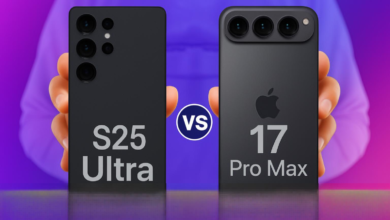
The relentless pursuit of Android Supremacy reaches a fever pitch with the arrival of two titans: the Google Pixel 10 Pro XL and the Samsung Galaxy S26 Ultra. These are not merely smartphones; they are manifestos, each representing a fundamentally different vision for the future of mobile technology. One, the purest expression of Google’s software-first, AI-integrated philosophy. The other, the apex of Samsung’s hardware mastery and all-encompassing ecosystem ambition. This comprehensive analysis dives deep into every facet of these flagship behemoths to determine which device truly claims the throne in the battle for Android Supremacy.
Design Philosophy: Minimalist Elegance vs. Industrial Power
The moment you hold these devices, their divergent paths are palpable. The Pixel 10 Pro XL continues Google’s tradition of understated sophistication. It features a matte-finish, recycled aluminum frame that feels warm and grippy, with a contoured visor-style camera bar that has now been seamlessly integrated into the chassis, eliminating any protrusion. The result is a device that is sleek, minimalist, and unmistakably Pixel. It prioritizes ergonomics and a clean aesthetic, available in muted, nature-inspired hues.
In stark contrast, the Samsung S26 Ultra is a statement of industrial might. It employs a new, ultra-durable titanium alloy frame with a sharper, boxier design that echoes a digital notebook. The iconic individual camera lenses are housed in a subtle, polished metal island. The S-Pen silo remains, a hallmark of its productivity-centric DNA. This phone feels like a precision tool—powerful, angular, and ready for business. It’s a design that commands presence but can be less comfortable for prolonged one-handed use compared to the Pixel’s curves.
| Design Aspect | Google Pixel 10 Pro XL | Samsung Galaxy S26 Ultra |
|---|---|---|
| Build Materials | Recycled Aluminum, Corning Gorilla Armor Victus 3 | Titanium Alloy Frame, Gorilla Glass Armor (Front & Back) |
| Dimensions & Weight | Elegant, contoured, lighter (~220g) | Larger, boxier, substantial feel (240g) |
| IP Rating | IP68 | IP68 (with enhanced dust resistance) |
| Signature Element | Integrated Visor Camera Bar | Built-in S-Pen, Individual Camera Lenses |
Display Showdown: The Canvas of Innovation
Both phones boast displays that push the boundaries of mobile viewing, but with different emphases. The Pixel 10 Pro XL features a 6.8-inch “Super Actua” LTPO OLED panel that achieves a record-breaking 3,500 nits of peak HDR brightness. This makes it the undisputed champion for outdoor visibility. Google’s focus is on color accuracy and a natural, paper-like viewing experience, enhanced by its Proactive HDR+ technology that adjusts tone mapping in real-time based on content.
The Samsung S26 Ultra counters with a slightly larger 6.9-inch Dynamic AMOLED 2X Quad HD+ display. While its peak brightness is marginally lower, it excels in other areas: a variable refresh rate that dips to an ultra-low 1Hz for power savings, and the unparalleled versatility offered by the S-Pen. The S26 Ultra’s display is also flatter, making it ideal for stylus input, and it supports Samsung’s advanced Vision Booster and AI-powered detail enhancement for upscaling content. It’s a display built for both media consumption and serious creation.
Performance & AI: The Heart of the Matter
This is where the battle for Android Supremacy gets truly philosophical. The Pixel 10 Pro XL is powered by Google’s next-generation Tensor G4 chip, co-developed with a focus on AI/ML acceleration, security, and seamless integration with Google’s data centers. Performance is fluid and optimized for Google’s services, but its raw synthetic benchmark scores might not top the charts. Its true power lies in on-device AI capabilities like Gemini Nano++, which enables real-time, offline translation, summarization, and generative photo editing that feels magical.
The Samsung S26 Ultra is equipped with the Snapdragon 8 Gen 4 for Galaxy (or Exynos 2500 in some regions), a traditional compute powerhouse. It delivers blistering CPU and GPU performance, excelling in gaming, multitasking, and heavy-duty applications. Samsung’s AI suite, Galaxy AI 2.0, is extensive and impressive, focusing on cross-app productivity (like advanced copy-paste between apps), generative wallpapers, and camera tricks. However, some features may rely more on cloud processing than the Pixel’s deeply integrated on-device approach.
| Performance Metric | Google Pixel 10 Pro XL (Tensor G4) | Samsung S26 Ultra (Snapdragon 8 Gen 4) |
|---|---|---|
| AI Focus | Deep on-device integration, contextual awareness, Gemini Nano++ | Broad feature set, productivity enhancements, Galaxy AI 2.0 |
| Gaming | Excellent for most titles; optimized thermal management | Top-tier; best-in-class GPU for demanding games |
| Multitasking | Smart, AI-predictive app management | Raw power for multiple heavy apps + DeX desktop mode |
| Ecosystem Link | Google Cloud, Photos, Assistant | Samsung Galaxy Tabs, Watches, SmartThings |
The Camera: Computational Mastery vs. Versatile Optics
The camera system is the most critical battleground for Android Supremacy. The Pixel 10 Pro XL doubles down on computational photography. It features a new 50MP wide sensor with a larger pixel size, a 48MP ultra-wide, and a 64MP periscope telephoto with 5x optical zoom. Google’s software is the star: “Proactive HDR+ Live” processes the viewfinder in real-time, and “Studio Light” can professionally relight portraits post-capture. Its low-light and portrait modes remain industry-leading, producing consistently stunning results with minimal user effort.
The Samsung S26 Ultra takes a hardware-first approach. It boasts a staggering 200MP adaptive pixel main sensor, a 50MP periscope telephoto with 5x zoom, a 12MP periscope with 10x optical zoom, and a 12MP ultra-wide. This arsenal provides unmatched optical versatility, from ultra-wide landscapes to incredible 10x close-ups and up to 100x digital “Space Zoom.” Samsung’s AI enhances detail and reduces noise, but the images tend to have a brighter, more saturated, and contrast-heavy signature compared to the Pixel’s more natural, computational look.
Software & Longevity: Pure Android vs. Feature-Rich Experience
The Pixel 10 Pro XL runs the cleanest version of Android 15, with guaranteed day-one updates directly from Google for five years, including major OS upgrades and security patches. The software experience is fast, uncluttered, and the first to receive new Google features like enhanced Call Screen, Hold for Me, and Magic Eraser improvements. It’s Android as Google intended.
The Samsung S26 Ultra runs One UI 7.0 on top of Android 15. It is a feature-packed interface offering immense customization, advanced multitasking (like true windowed apps), and deep integration with Samsung’s ecosystem (Galaxy Buds, Watch, etc.). Samsung now promises 7 years of OS and security updates, setting a new industry standard. However, the update rollout can be slower than Google’s, and the interface, while refined, is heavier.
Battery Life and Charging
The Pixel 10 Pro XL houses a 5,500 mAh battery, optimized by the efficient Tensor G4 chip and Android’s adaptive battery features. It excels at providing consistent all-day life. It supports 45W wired charging and 30W wireless charging. The Samsung S26 Ultra packs a larger 5,800 mAh battery to power its expansive display and high-performance chipset. It supports 65W wired charging, 15W wireless, and 4.5W reverse wireless charging. In real-world usage, both easily last a full day, with the S26 Ultra having a slight edge in recharge speed.
Verdict: Defining Android Supremacy
So, who wins the battle for Android Supremacy? The answer depends entirely on what Android Supremacy means to you.
Choose the Google Pixel 10 Pro XL if you value a cohesive, intelligent, and effortless experience. It is for the user who believes the smartphone should be an intuitive assistant, a camera that always gets the shot, and a gateway to the latest AI innovations in a clean, minimalist package. Its Android Supremacy is defined by software intelligence and seamless Google integration.
Choose the Samsung Galaxy S26 Ultra if you demand the ultimate in hardware versatility, raw power, and productivity. It is a pocket-sized computer, a creative studio, and a multimedia powerhouse. With its S-Pen, incredible optical zoom range, desktop DeX mode, and longest update promise, it is the device for power users who want to do everything. Its claim to Android Supremacy is built on hardware dominance and unparalleled feature depth.
In conclusion, both the Pixel 10 Pro XL and the Galaxy S26 Ultra are phenomenal achievements, each reigning supreme in its own kingdom. The Pixel is the king of AI and computational elegance. The S26 Ultra is the emperor of hardware and versatile power. The true winner in this battle for Android Supremacy is the consumer, presented with two distinct, yet equally compelling, visions of the smartphone’s future.
Frequently Asked Questions (FAQ)
- Which phone has a better camera for everyday use? The Pixel 10 Pro XL generally produces more consistently pleasing point-and-shoot photos with superior computational photography, especially in portraits and low light.
- Which phone is better for gaming and heavy multitasking? The Samsung S26 Ultra, with its more powerful Snapdragon chipset and higher RAM configurations, has a clear edge in sustained gaming performance and running multiple demanding apps simultaneously.
- Which phone receives software updates faster? The Google Pixel 10 Pro XL receives Android version and security updates directly from Google on the day they are released, making it the fastest.
- Which phone has better battery life? Both have excellent all-day battery life. The S26 Ultra has a slightly larger battery and faster charging, but the Pixel’s software optimization is incredibly efficient. The difference in real-world use is often marginal.
- Is the S-Pen a deciding factor? For note-takers, digital artists, or those who value precise control for editing or remote camera use, the built-in S-Pen on the S26 Ultra is a unique and powerful feature that the Pixel cannot match.
- Which phone offers better value? Value is subjective. The Pixel offers a premium experience focused on AI and camera at a potentially lower price point. The S26 Ultra justifies its premium with top-tier hardware, the S-Pen, and extreme versatility, often making it the more expensive option.